The European Commission adopted the Horizon Europe (HE) Work Programme 2026-2027 on December 25. More than 14,000 million euros are allocated for research and innovation for the proposals included in HE as well as other proposals included in the Work Programme (WP).
At Contactica we review the information collected on the European Commission‘s portal to bring you the essential and necessary information to foresee the development of the calls in the coming months.
Several opportunities for 2027 are scheduled to open during the final months of 2026, with others starting in the middle of the following year.
However, for organisations considering a Horizon Europe proposal in 2027, the preparation period starts much earlier.
The extended deadlines offer potential applicants an important window to identify the right topic, assess the fit of the project, build the consortium and prepare the proposal before the call deadline approaches.
Horizon Europe 2027: upcoming calls, budgets and key dates
What is the different in the Horizon Europe 2026-2027 Work Programme?
The invest of €14 billion destinated to the Work Programme (WP) does more than introduce another round of topics. Itself reflects several changes in the way Horizon Europe funding is being organised.
One of the novelties is the introduction of horizontal calls, designed to address challenges that cut across different research and innovation areas. These include a major call supporting the Clean Industrial Deal, with around €540 million, alongside approximately €90 million for AI in Science. The latter supports trustworthy uses of artificial intelligence in areas including advanced materials, agriculture and healthcare.
The programme also highlights the importance of simplifying applications. According to the European Commission, the 2026 – 2027 WP is around 33% shorter than the 202-2024 edition, around half of the call budget is planned through lump-sum funding, and 41 topics use a two-stage evaluation procedure. As it mentioned on the webpage: “Short proposal first, full proposal only if invited”
Climate remains another major component. At least 35% of the €14 billion Work Programme is dedicated to climate objectives, alongside initiatives supporting industrial decarbonisation and clean technologies.
But what does the calendar look lie across the six clusters?
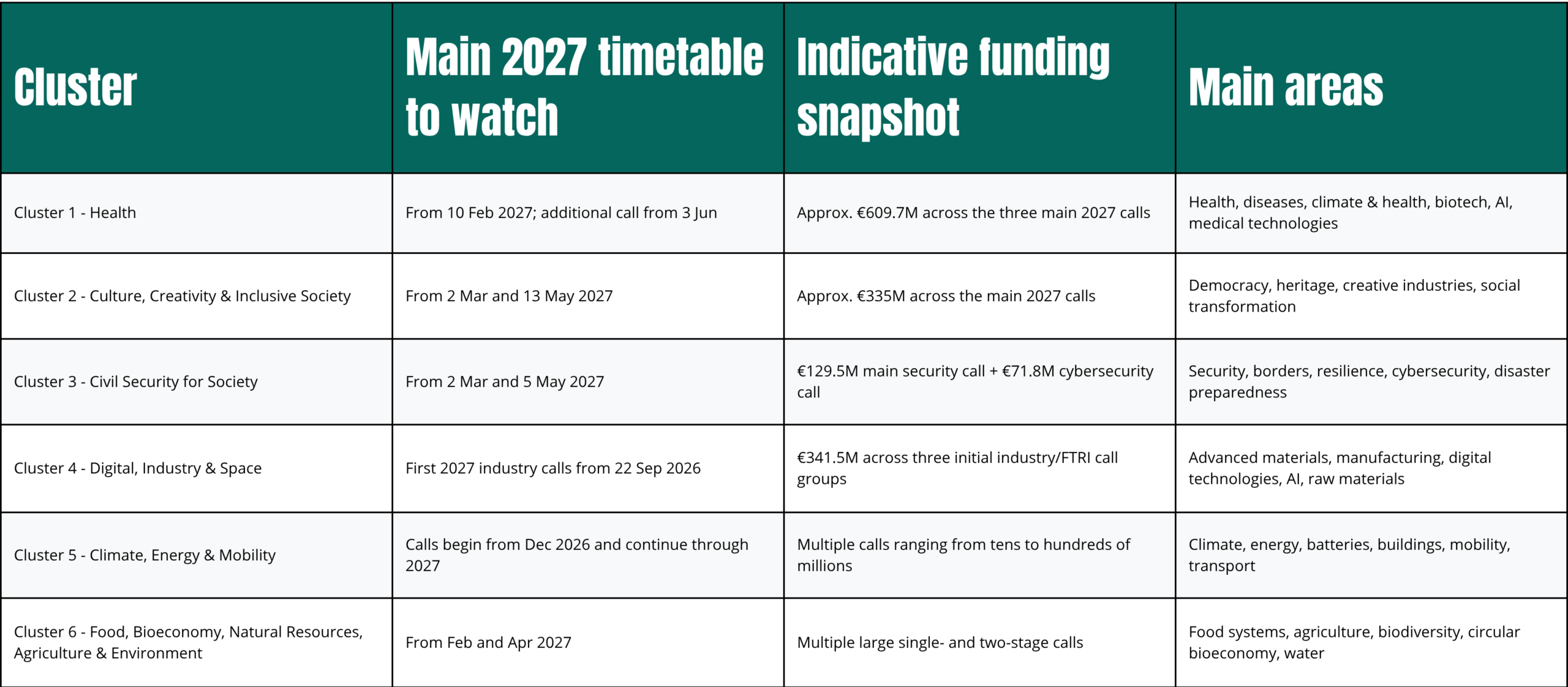
Explore the six Horizon Europe clusters for 2027
Cluster 1 – Health
Health remains a major area of Horizon Europe (HE) funding in 2027, with opportunities covering disease prevention and treatment, climate-related risk, biotechnology and artificial intelligence.
The 1st large 2027 Health Call, HORIZON-HLTH-2027, is scheduled to open o 10 February 2027, with a deadline on 13 of April and an overall indicate budget of €341.9 million. Topics include climate-related exposures and health, novel antiviral treatments, antimicrobial resistance, personalised approaches to adverse drug reactions and new biological production technologies
A parallel two-stage call will also open on 10 February. Its first-stage deadline is 13 April, followed by a second-stage deadline on 22 September 2027. The call has an indicative budget of €186.6 million and includes research on non-communicable diseases, neurodegenerative diseases, AI-based predictive biomarkers and point-of-care diagnostics.
A further €81.5 million single-stage call is planned from 3 June to 22 September 2027, including topics on bioprinting of living cells, Virtual Human Twins and AI for healthcare.
This places the combined indicative budget of these three major 2027 Health calls at approximately €609.7 million.
Cluster 2 – Culture, Creativity and Inclusive Society
Cluster 2 addresses challenges related to democracy, cultural heritage and social and economic transformation.
In two-stage 2027 call is expected to open on 2 March 2027, with a first deadline on 4 May 2027 and a second on 30 September 2027. It includes open topics on European democracy and cultural heritage, alongside research addressing the socio-economic situation of people with dementia and informal carers. Its indicative budget is €58 million.
The larger single-stage call follows on 13 May 2027, closing on 23 September, with an indication budget of €277 million. Topics range from democratic participation and media freedom to AI, the cultural and creative industries, sustainable tourism, education, inclusion and social economy.
Together, these calls represent approximately €335 million in indicative 2027 funding.
Cluster 3 – Civil Security for Society
For Cluster 3, organisations should distinguish between the main Civil Security for Society call and the dedicated cybersecurity opportunities.
The main call, HORIZON-CL3-2027-01, is scheduled to open on 5 May 2027 and close on 4 November 2027, with an indicative budget of €129.5 million. It covers crime and terrorism, border management, resilient critical infrastructure, disaster preparedness and innovation uptake in the security sector.
A separate cybersecurity call managed through the European Cybersecurity Competence Centre is planned from 2 March to 15 September 2027, with €7.8 million available.
This makes cybersecurity and advanced digital security and especially visible component of the 2027 programme.
Cluster 4 – Digital, Industry and Space
Cluster 4 is particularly relevant already in 2026.
The first of 2027 industry calls is scheduled to open on 22 September 2026, several months before the start of 2027. The main single-stage Industry call has an indicative budget of €224 million, covering advanced materials, manufacturing, circular industrial processes, technology infrastructures, commercialisation and critical raw materials.
A further €82.5 million two-stage call focuses on renewable energy use in process industries and nee approaches to collaboration between people and AI in the future workforce. It first deadline is scheduled for 2 February 2027, with successful first-stage applicants progressing towards a second deadline on 2 September 2027.
Another €35 million is allocated to fast-track research and innovation topics for industrial technologies and the chemical industry.
Taken together, those initial Industry and Fast Track call groups represent around €341.5 million and illustrate why applicants should not wait until 2027 to start analyzing next year’s opportunities.
Further Digital and Space opportunities follow under the same Work Programme, covering areas such as AI, data infrastructures, robotics, photonics, advanced computing, circular industries and space technologies.
Cluster 5 – Climate, energy and Mobility
Cluster 5 is one of the broadest parts of Pillar II. It covers climate science, renewable energy, energy systems, buildings, batteries, industrial transition, transport and smart mobility.
The 2027 programme includes several separate call groups rather than a single common calendar. Some are scheduled for December 2026, while others will open later in 2027.
Examples include a €227.6 million call covering batteries and energy technologies, with topics on battery recycling and cell production, solar technologies, wave and tidal energy, renewable energy valleys, AI for energy systems and direct air capture.
A Mobility call opening on 15 December 2026 and closing on 14 April 2027 carries an indicative budget of €131 million. It includes e-mobility, zero-emission buses and coaches, heavy-duty electric vehicles, aviation and waterborne transport.
Other 2027 calls address next-generation batteries, buildings and industrial energy efficiency, connected and automated mobility and additional renewable-energy technologies. Later calls extend as far as December 2027, illustrating how widely the Cluster 5 calendar is distributed throughout the year.
For applicants in climate-tech, energy or mobility, the key lesson is therefore to look beyond a single annual deadline and map the relevant Destination and topic well in advance.
Cluster 6 – Food, Bioeconomy, Natural Resources, Agriculture and Environment
Cluster 6 brings together an especially diverse portfolio of opportunities related to biodiversity, agriculture, food systems, circular economy, bioeconomy, natural resources, rural communities, environmental observation and climate action. The 2027 programme contains several single and two-stage calls.
Two-stage opportunities are scheduled to start as early as 4 February 2027, with first-stage deadlines in April and second-stage deadlines in September. These include opportunities related to the circular bioeconomy and the European Water Resilience Strategy.
The main single-stage calls are scheduled to open on 20 April 2027, with deadlines around 22–23 September.
Among the topics included are biodiversity observation, ecosystem restoration, agricultural resilience, sustainable food systems, livestock, microbiomes, organic farming, rural communities and bioeconomy solutions. One of the principal single-stage call groups alone carries an indicative budget of €182.85 million.
For organisations working in agri-food, biotechnology, environmental solutions or circular bioeconomy, Cluster 6 therefore offers a particularly broad range of possible entry points.
Beyond the six clusters
The six Pillar II clusters are only one part of the 2026-2027 Horizon Europe landscape.
The Work Programme (WP) also includes opportunities under Marie Skłodowska-Curie Actions, Research Infrastructures, European Innovation Ecosystems, WIDERA, EU Missions, the New European Bauhaus Facility and horizontal activities, while the ERC and EIC operate through separate Work Programmes.
For companies developing market-oriented technologies, it also worth looking beyond an individual Horizon Europe topic and considering how instruments such as the European Innovation Council and other European funding programmes could support later stages of development and commercialisation.
Preparing for a Horizon Europe 2027 call: why start now?
Finding a promising call is only the first step.
Applicants need to understand the expected outcomes and scope of the topic, determine whether the project maturity and consortium match the requirements, analyse the type of action and funding model, and establish a credible pathway towards the expected impact.
This becomes especially important for calls opening in late 2026 or early 2027. By the time a call officially opens, organisations should ideally already have a clear project concept and know which capabilities or partners are still missing.
The publication of the 2026–2027 Work Programmes therefore offers organisations an opportunity to plan their funding strategy before the proposal-writing period begins.
Looking for the right European funding opportunity?
CTA helps organisations navigate European research and innovation funding, identify opportunities aligned with their projects and transform innovative ideas into competitive European proposals.
Whether you are assessing the right Horizon Europe call, defining your project strategy, identifying partners or preparing the proposal, our team can support you throughout the process.
Get in touch with Contactica and start preparing for the next European funding opportunity.